I was wrong about Kendrys Morales.
If there’s any comfort in the above statement, it’s that I wasn’t alone in my skepticism.
Let’s rewind ourselves. After the 2014 season, the Royals bid farewell to folk hero Billy Butler and declared the designated hitter spot to be an open space among hitters on the roster. Maybe the Royals would rotate a few guys in the postition, to give some a break from duties in the field. Maybe someone would step forward and take charge enough to get three or four games a week. Ha. We know Ned Yost doesn’t play that game. He likes a set roster with set roles.
So the Royals went and signed free agent Morales to a two year deal with $17 million. Morales made $6.5 million in 2015, is due $9 million in 2016 and has a - wait for it - mutual option worth $11 million for 2017 with a $1.5 million buyout. That was a lot of scratch to give a player who struggled the seasons before joining the Royals, posting the worst offensive season of his career. Myriad reasons were given for Morales’s lack of offense, most of which focused on the qualifying offer that depressed his market and prevented him from signing until June. Missing spring and the first couple months of the season, Morales never got on track. So said the conventional wisdom.
Because this is the Royals, we really should have seen how this was going to end. Morales rewarded the faith of the Royals with the second best offensive season of his career, and his best since he shattered an ankle celebrating a walk-off grand slam in 2010. Quite a rebound.
A switch-hitter, Morales has historically been stronger from the left side of the plate. His career OPS is roughly 90 points higher from this side. He comes by it honestly, as his ability to reach base and his power are both better when he hits left-handed. That’s pretty much how his 2015 season played out, with much better production coming when Morales hit from the left side. However, the gap wasn’t as pronounced when it came to reaching base. The big difference was in the power department.
| Split | PA | AB | H | 2B | 3B | HR | RBI | BB | SO | tOPS+ | sOPS+ | |||||
|---|---|---|---|---|---|---|---|---|---|---|---|---|---|---|---|---|
| vs RHP as LHB | 377 | 331 | 94 | 28 | 1 | 18 | 65 | 36 | 65 | .284 | .363 | .538 | .901 | .303 | 111 | 139 |
| vs LHP as RHB | 262 | 238 | 71 | 13 | 1 | 4 | 41 | 22 | 38 | .298 | .359 | .412 | .771 | .340 | 84 | 110 |
Generated 2/3/2016.
Morales collected 29 more extra base hits as a left-handed hitter in roughly 100 more plate appearances.
If you like your saber metrics slightly more advanced, FanGraphs had Morales at a 146 wRC+ as a left-handed hitter versus a 110 wRC+ from the right side. His left-handed batting split of 146 wRC+ is a great stat, but taken in perspective, it’s not like it stands out against the rest of the league. It’s the same amount totaled by Yoenis Cespedes and Prince Fielder, good for the 19th best wRC+ in baseball on that particular split. Yet, it was the highest total on the Royals, which is why his bat was a delight to have in this lineup. Think about the left-handed thunder at the Royals disposal: Eric Hosmer (141 wRC+), Mike Moustakas (123 wRC+), and Alex Gordon (120 wRC+). OK, thunder may be a bit of a stretch. But as Uncle Hud likes to say, “You can’t sneak a piece of cheese past a hungry rat.” How about we amend that to say something like, “You can’t sneak a right-handed pitcher past these hungry lefty bats.”
Given that his power profile tilts toward the left side, it’s not surprising Morales’s power production is to right and right-center. Here’s where his 22 home runs landed, according to Hit Tracker.
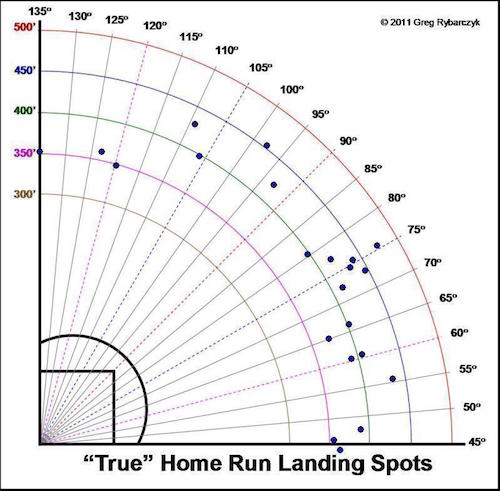
One thing that jumps out from the chart is the fact Morales hit some absolute bombs. The power was real, and it was spectacular. According to Hit Tracker, Morales of the 22 bombs he launched, 15 were classified as having “plenty” or “no doubt” status. The average speed of the ball of the bat was 103.7 mph and his average true landing distance was a shade over 400 feet at 403.6 feet. He played his home games in a yard that is supposed to suppress power, yet there wasn’t a ballpark that could contain Morales if he caught one right in 2015.
Morales crushed the hard stuff last year, no matter what side of the plate he was standing. From PITCHf/x data collected from Brooks Baseball, if a pitcher tried to sneak a fastball past Morales in 2015, he made them pay.
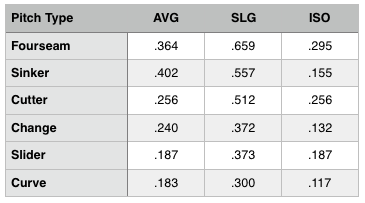
That’s pretty much the breakdown on his splits as well. If you wanted to get Morales out in 2015, you jumped ahead in the count and then you fed him offspeed and breaking pitches. Sure, that’s basically the MO against any hitter, but with Morales, it was pretty pronounced.
If you were a pitcher crazy enough to enjoy the challenge of getting the hard stuff past Morales, where would you go? Well, like any left-handed hitter, he liked pitches down and in. And like any right-handed hitter, he liked to get his arms extended to yank one to his pull field. So if I were advising a pitcher with a death wish, I’d strongly suggest he keep the pitch on the third base side of the plate and maybe keep it down. But not too far down.
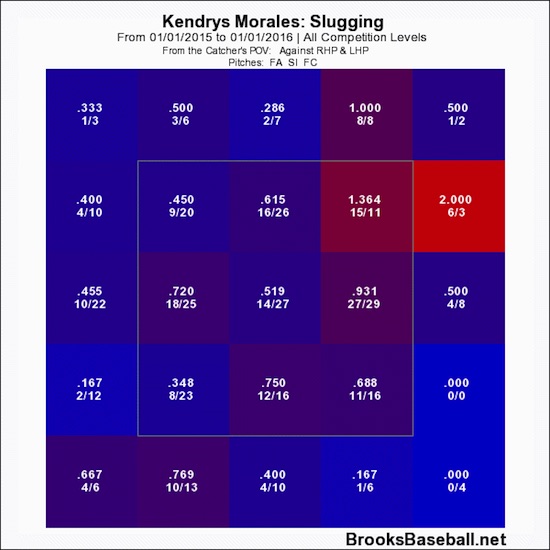
There just weren’t holes in Morales’s offensive game in 2015. Next year is his age 33 season. Can we expect him to continue to perform at this level? Probably not. But the way he was punishing the ball last year, if there’s any falloff in production, I’d bet it would be incremental. ZiPS has Morales projected for 30 doubles and 18 home runs with a .276/.336/.444. Steamer is guesstimating 31 doubles and 19 home runs, good for a line of .270/.334/.440. I’m a little more optimistic, thinking a line of around .285/.345/.455 is a nice target.
Turns out that free agent signing in December of 2014 wasn’t such a bad piece of business.
Forever Royal
I’ve been toying around with including this feature in player profiles, but have yet to follow through. Now feels like the right time to start.
When Morales stepped to the plate in the bottom of the eighth inning in Game Five of the ALDS, the Royals already owned a two run lead and were three outs away from advancing to the Championship Series. Morales made sure the outcome wasn’t in doubt.
A glorious moment that reveled in the high drama of the postseason. That’s exactly why these Royals October games were great theater. An elimination game. An early deficit. The Royals chip away. The lead is secure - at least it feels secure with Wade Davis in the bullpen - but there is still a nervous energy. Another run - or two - would add to the cushion and give some comfort. Screw that, says Morales, as he launches a bomb to left-center.
It was a laser, leaving his bat at 113.7 mph, the third hardest home run he hit all year, and traveling 440 feet.
Worth it.